From the November 2026 digital edition · Read on magazine page 6
Listen to this article (12 min)
Watch the video version (12 min, the story’s slides with the narration)
Agricultural technology companies are offering California growers new ways to reduce labor, conserve water and cut input costs. But as more equipment enters the market, growers face a familiar question: Will the investment pay off?
The answer depends on more than what a machine can do during a demonstration. Growers need to know how it performs under commercial conditions, what it costs to operate and whether the savings justify the investment.
Those questions were part of a recent UC Agriculture and Natural Resources (UC ANR) Connect AgTech Field Day near San Juan Bautista, where companies demonstrated precision spraying equipment, soil treatment technology and other tools aimed at improving production efficiency. UC researchers also presented technology developed in collaboration with growers.
Helle Petersen, director of UC ANR Innovate, said growers should start by determining whether a technology addresses a problem in their operation.
“The tech needs to solve a real problem, work reliably under real farming conditions and make financial sense for the grower’s farming operation,” Petersen said.
Growers also need to look closely at manufacturers’ claims and how the results were achieved.
Measuring Savings in the Field
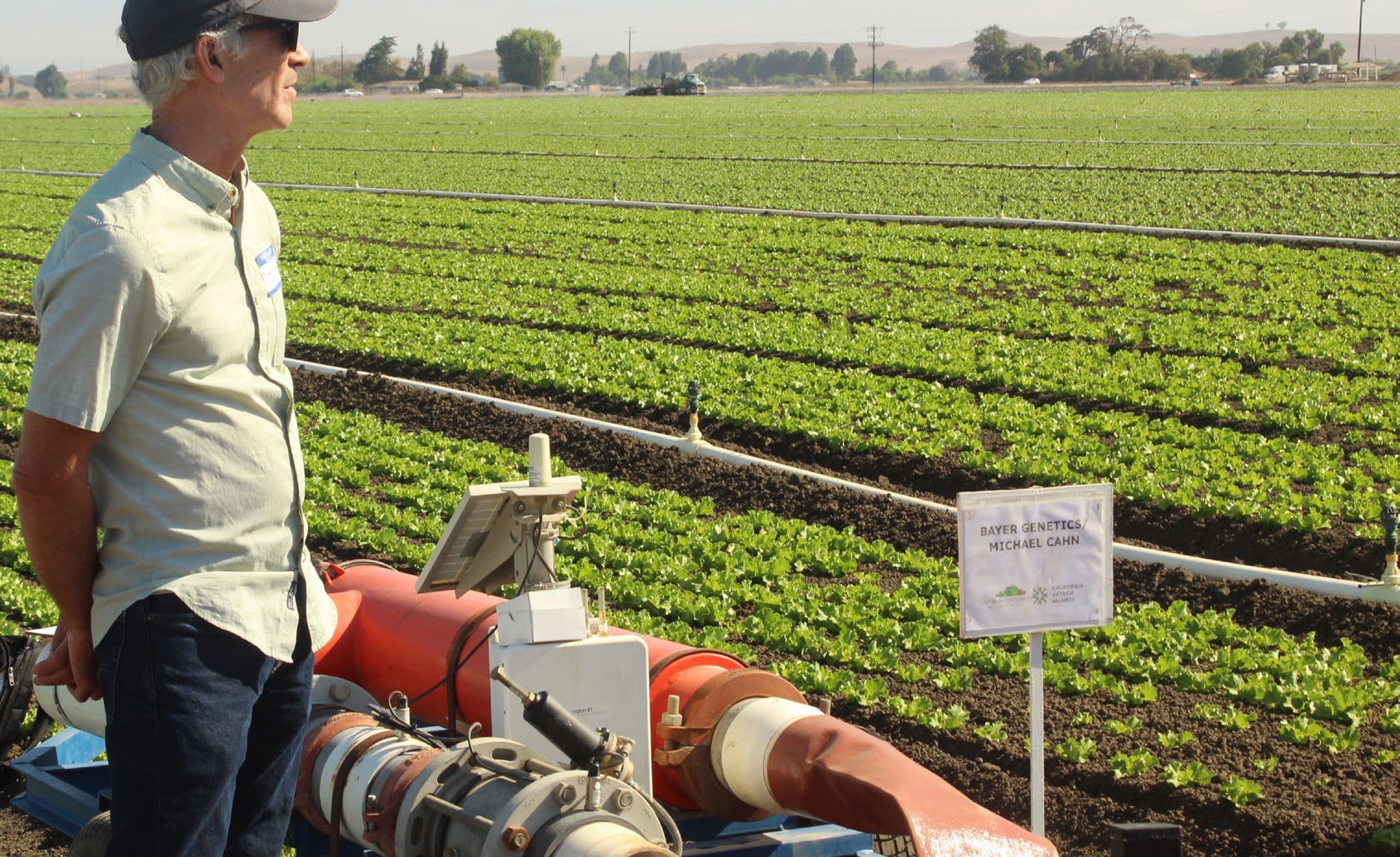
Michael Cahn, a University of California Cooperative Extension (UCCE) irrigation researcher based in Salinas, presented a mobile irrigation monitoring system developed in collaboration with Huntington Farms.
The system addresses a challenge in Salinas Valley vegetable production, where growers often have multiple fields at different stages of development and use both drip and sprinkler irrigation.
Drip systems operate at much lower pressures than sprinklers. When pressure is too low, water distribution can become uneven, affecting fertilizer applied through the drip system. Growers may compensate by irrigating longer or applying more fertilizer.
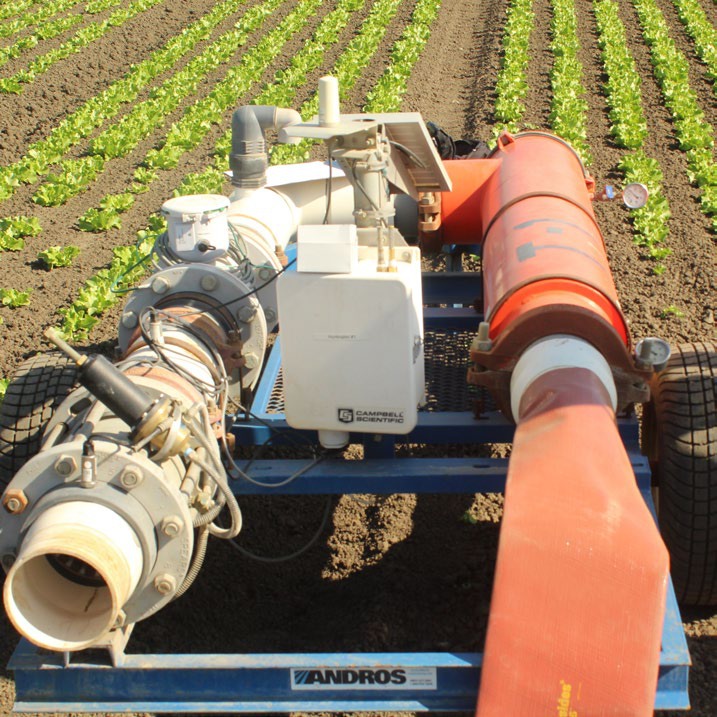
Cahn and his collaborators developed a mobile platform equipped with a pressure regulator, flow meter and sensors to monitor irrigation performance. Information is transmitted to UC-developed CropManage software, allowing irrigators to check pressure and flow remotely.
During his field-day presentation, Cahn reported water savings of approximately 20% and nitrogen fertilizer savings of 30% over four years of using the system at Huntington Farms.
Petersen said multi-year field results can be valuable when evaluating new technology.
“Having four years of results is good because it gives you more confidence that the savings hold up across seasons, rather than just under one set of conditions,” she said.
Growers considering similar technology would still need to evaluate how the results might differ under their own conditions, along with the costs of installing and operating the system.
The value of those savings can also change as water, energy and fertilizer prices fluctuate.
“I would want to know whether the investment still makes sense in a year when the savings are smaller or input prices are lower, after accounting for the ongoing costs of using the technology,” Petersen said.
The project received funding through the California Department of Food and Agriculture’s State Water Efficiency and Enhancement Program. Local irrigation company Brigantino Irrigation assembled the mobile equipment.
The Costs Growers Don’t Always See
Even technology that delivers measurable savings can come with expenses beyond the purchase price. Installation, training, subscriptions, maintenance and repairs all affect the return. Growers also need to consider how much time employees spend monitoring equipment, interpreting data or completing tasks the technology can’t handle on its own.
Petersen said downtime can be especially costly during planting and harvest, when growers have limited windows to complete fieldwork.
“If it stops working during planting or harvest, how quickly can you get help or replacement parts? You have a limited window to get that work done, so downtime can quickly eat into the expected savings,” she said.
Cahn’s irrigation system provides an example. The equipment uses cellular connectivity to transmit data at a subscription cost of about $10 per month. Cahn said connectivity has generally been reliable in the Salinas Valley, although some locations require an additional antenna. The system also contains filters that need periodic cleaning.
“So, all these tools are great, but if you don’t maintain them, you’re going to find out in a year or two they’re not working,” Cahn said.
The equipment was designed to move between fields, an important consideration in vegetable production.
Cahn explained that some automated irrigation companies have concentrated on permanent crops, where irrigation infrastructure remains in place. That equipment doesn’t necessarily meet the needs of vegetable growers who move irrigation systems as crops are planted and harvested.
“I think in the Salinas Valley, we have to sort of innovate for what we need,” he said.
A Different Approach to Soil Treatment
For some technologies, growers don’t need to purchase equipment at all.
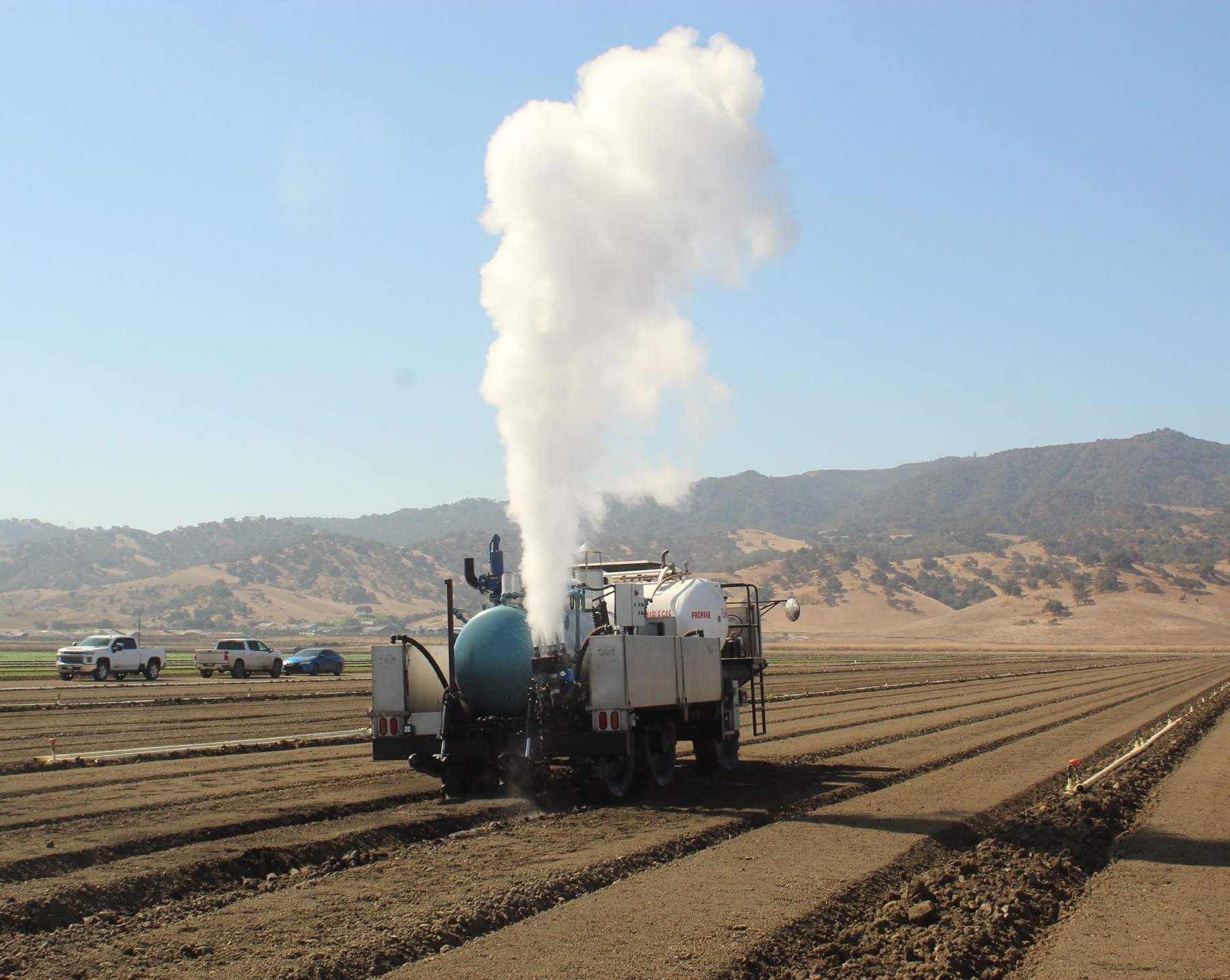
Salinas-based High Degree Machinery is developing a steam-based soil treatment service aimed primarily at strawberry production. Founder Austin Bowie said the technology uses steam to heat soil to approximately 160 to 180 degrees Fahrenheit to manage soilborne diseases and weeds before planting.
High Degree charges approximately $5,000 per acre for strawberry treatment, which Bowie said is comparable to current fumigation costs.
The company sees particular opportunities in organic production and conventional acreage where fumigation is restricted by buffer zones near homes or other sensitive sites. Rather than purchasing specialized equipment, growers pay High Degree to perform the treatment.
Bowie said the company has conducted research through grants involving UC Santa Cruz, although those trial results have not yet been published. He also pointed to previous research on soil steaming that has shown promising results compared with fumigation.
High Degree is still refining its equipment and expects to expand its fleet over the next several years, according to Bowie.
While the service model eliminates the need for growers to purchase and maintain machinery, treatment effectiveness, equipment capacity and the ability to complete work within planting windows will determine how widely the technology can be used.
What Do Input Reductions Really Save?
Precision spraying equipment offers another opportunity to reduce production costs, particularly where growers make multiple applications throughout the season.
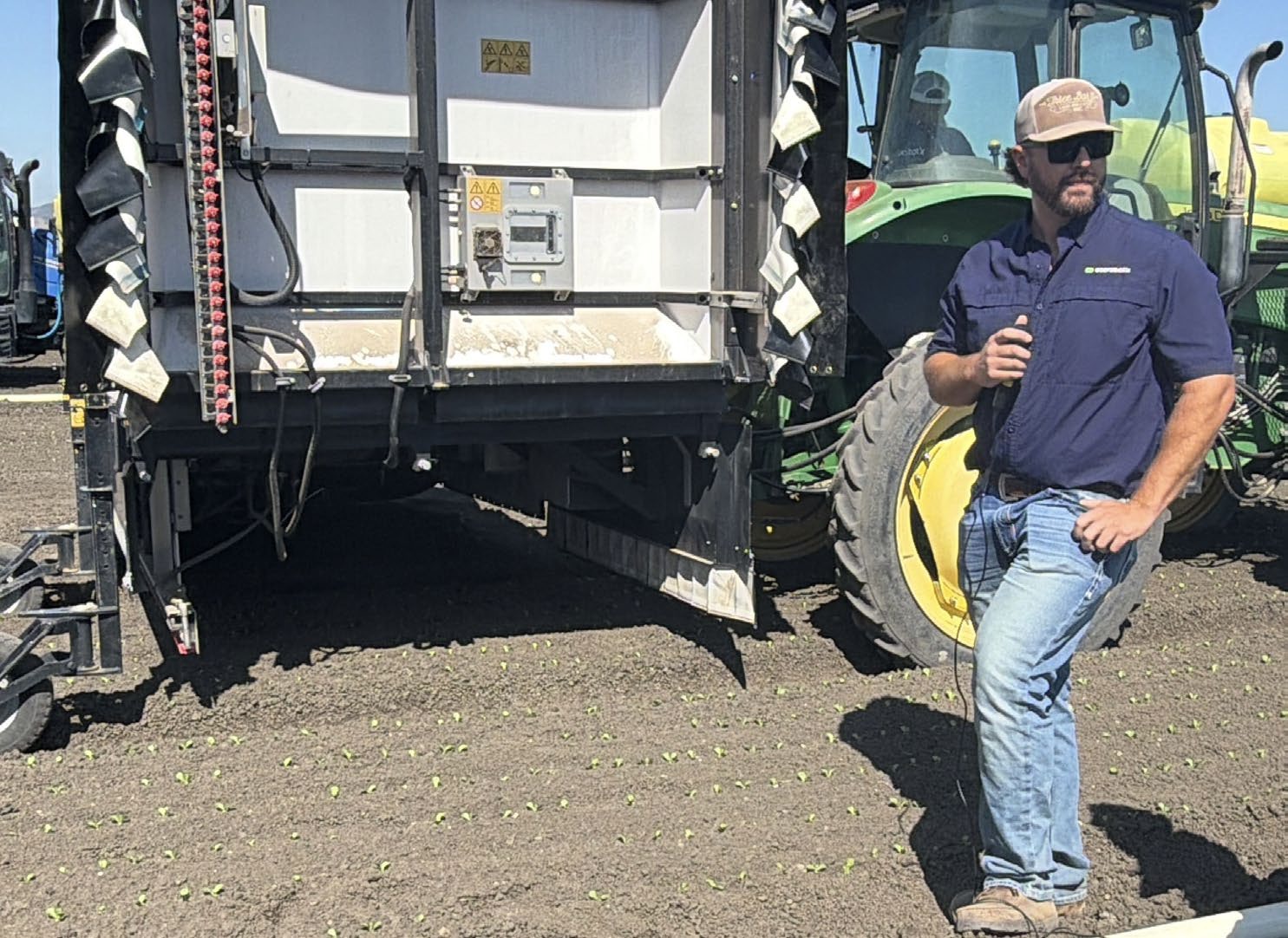
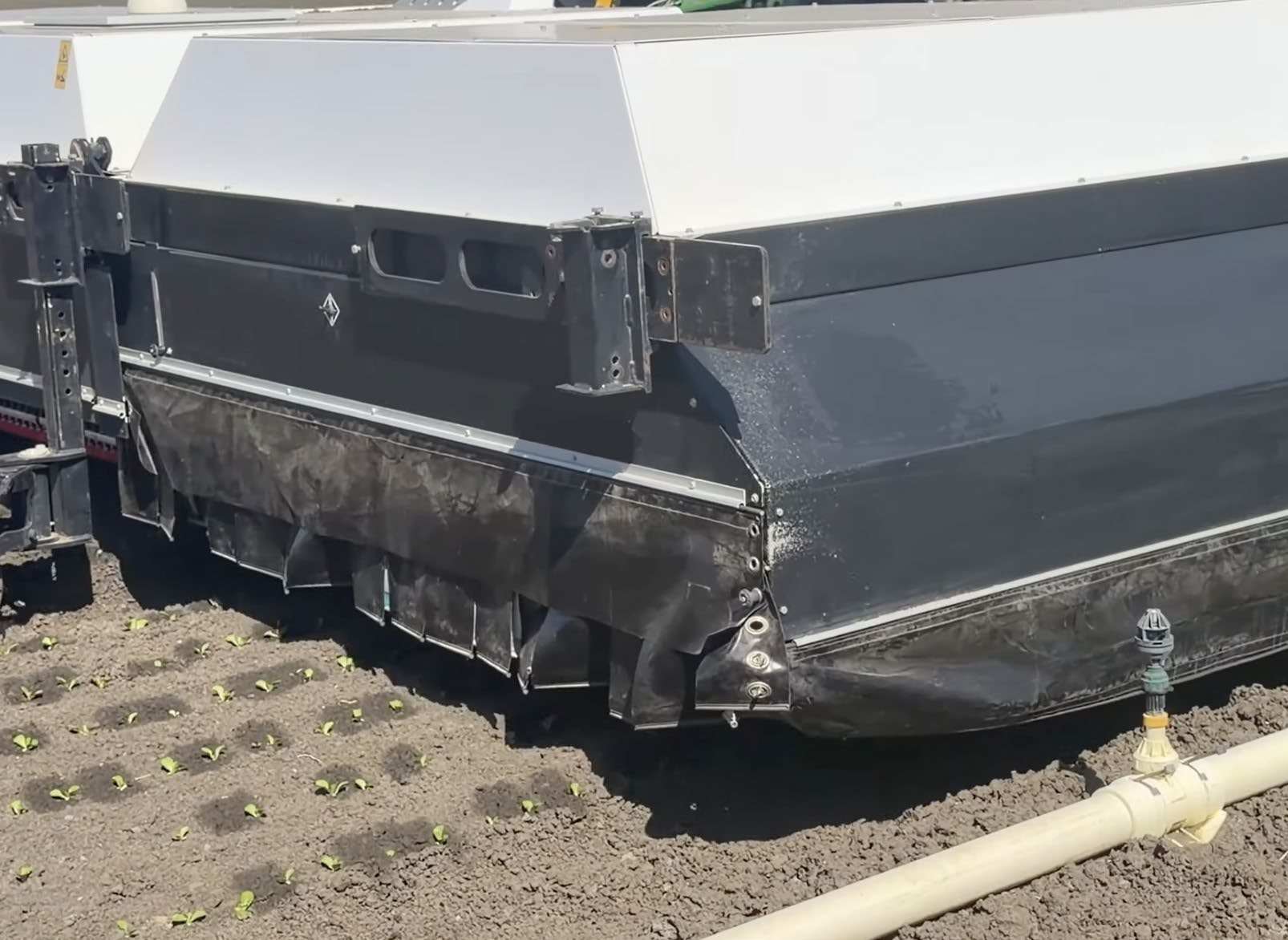
At the field day, Ecorobotix demonstrated its ARA precision spraying system, which uses cameras, artificial intelligence and individually controlled nozzles to identify plants and direct applications. The machine can be used for thinning, weeding and targeted crop applications.
Caylin Cole, Ecorobotix’s pre-sales regional manager for the Southwest, reported spray material reductions of approximately 65% to 85%, with the higher end reflecting his experience operating the machine. Cole said the equipment can cover 60 to 80 acres per day once operators become familiar with it.
Those reductions could represent significant savings, but the amount of material used is only one part of the financial calculation.
Petersen said growers should ask the manufacturer a few questions about how they arrived at their results.
“I would ask, ‘What are you comparing it with?’ If a company says it saves 30 percent, what crop was that in, under what conditions and over how much time?”
Growers also need to account for equipment costs, annual acreage, maintenance and whether crop performance is maintained.
Labor savings require similar scrutiny.
“A technology might let that person do other work, which can be really useful, but replacing a task does not necessarily mean replacing a job,” Petersen said.
A machine that allows employees to accomplish more work may improve efficiency without reducing payroll expenses. Both benefits have value, but they affect the return on investment differently.
Making Technology Fit the Operation
New equipment may also require changes to existing production practices.
Ryan O’Callaghan of Seminis Vegetable Seeds, part of Bayer Vegetable Seeds, discussed how plant breeding is evolving to accommodate automated field equipment.
The company is working on broccoli characteristics that allow automated harvesters and camera systems to identify and cut crowns more accurately. Seed uniformity is also becoming more important as precision planting and automated equipment depend on consistent plant spacing.
“As they develop technology, we’ve got to make sure our stuff’s adaptable,” O’Callaghan said.
Petersen said compatibility with existing equipment, crews and farming practices should be part of any investment decision, since technology that requires extensive changes to an operation may create additional costs or complications.
She also encouraged growers to look for results from comparable farms and, when possible, test equipment on a smaller scale before making a larger investment.
The Value of Independent Testing
As more agricultural technologies enter the market, independent research can help growers determine whether manufacturers’ claims hold up under commercial conditions.
Petersen said UC ANR can provide that perspective through testing at research and extension centers and on cooperating farms.
“Growers need credible validation and an unbiased perspective,” she said.
UCCE advisors bring knowledge of local crops and production systems, while agricultural economists can help evaluate costs, savings and potential payback. UC ANR Innovate connects growers and technology developers with those resources.
The technologies demonstrated near San Juan Bautista address different production challenges, but growers still need to know how they’ll perform in their own fields. That means looking beyond a demonstration or a manufacturer’s savings claims.
Petersen said firsthand experience can help growers make that decision.
“Seeing results from similar farms, and having an opportunity to test it themselves, can go a long way toward building that confidence,” she said.