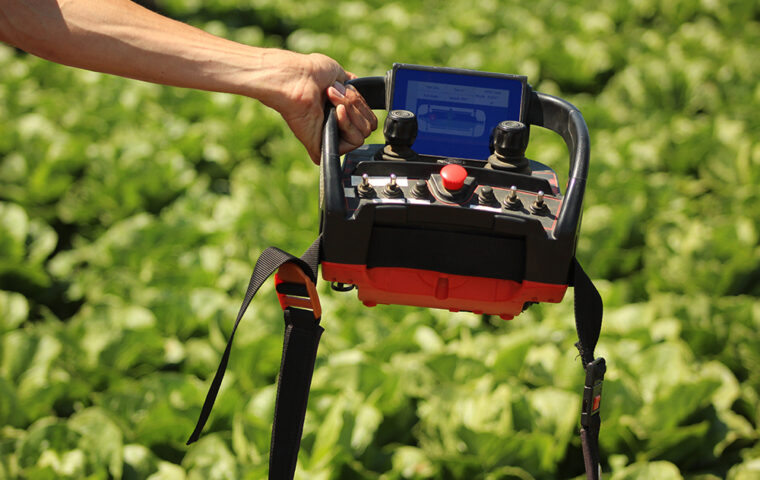
A new on-farm innovation hub in Salinas is helping ag-tech startups accelerate product development by connecting entrepreneurs with growers, equipment and real-world field testing.
When launched in 2021, TRIC Robotics struggled to manifest the company’s vision of providing pest control with ultraviolet light in strawberries.
“We were literally building in the dirt with the wrong tools,” said CEO and founder Adam Stager.
Today, the company’s platforms are operating in strawberry fields in Santa Maria and Oxnard, Calif., and the company is working with partners of a new incubator farm in Salinas in hopes of expanding into the fertile Salinas Valley.
TRIC Robotics is one of several ag technology startups embracing opportunities at Reservoir Farms, an on-farm innovation hub that opened in March 2026 in Salinas. The site features innovation barns where companies can refine machinery with high-end fabrication equipment, office spaces and 24 acres of dedicated commercial fields where companies can test their ideas in the field.
We were literally building in the dirt with the wrong tools. —Adam Stager
“It is a huge benefit for us,” Stager said of working with Reservoir Farms. “You’ve got companies like Andros Engineering outfitting a shop with not only the right tools, but also the right tools just feet away from the farm. So, you can get out on the farm and get to work really fast.”
Adam Stager
“It is a huge benefit for us,” Stager said of working with Reservoir Farms. “You’ve got companies like Andros Engineering outfitting a shop with not only the right tools, but also the right tools just feet away from the farm. So, you can get out on the farm and get to work really fast.”
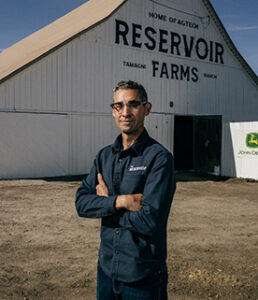
Reservoir Farms is the brainchild of Danny Bernstein, founder and CEO of Reservoir, an agricultural innovation center and venture capital fund focused on helping ag-tech startups succeed. The idea of forming incubator farms for ag-tech is nothing new, according to Matthew Hoffman, general partner and head of Reservoir Farms, but Bernstein made it happen.
“Danny gets a lot of credit for taking the leap and making it happen,” Hoffman said. “And Western Growers, John Deere and Taylor Farms, who are our major strategic partners, also get an incredible amount of credit. Those three businesses really legitimized and put some wind in the sails of Reservoir in the early days.”
Matthew Hoffman
“Danny gets a lot of credit for taking the leap and making it happen,” Hoffman said. “And Western Growers, John Deere and Taylor Farms, who are our major strategic partners, also get an incredible amount of credit. Those three businesses really legitimized and put some wind in the sails of Reservoir in the early days.”
Reservoir launched on the concept that getting an idea from the lab or shop to the field is extremely difficult for smaller-scale ag-tech companies, particularly those working in specialty crops. Reservoir research showed that it takes about eight months from the time a startup is funded to the time it can establish a relationship with a grower and get into a field for testing. “And when you only have, say, $100,000 to $500,000 in the bank with some angel investment or your own capital, spinning your wheels for eight months is pretty bad,” Hoffman said.
Tiered partnerships
Reservoir Farms partners with startups on a couple of different levels, including a community-scale membership, where companies can network with growers and high-end ag-tech companies; and a residence membership, where companies have access to office space, shop space and field space.
Currently, four companies are in residence at the Salinas flagship farm, and Hoffman said the farm could accommodate another five or six. Reservoir also has a campus in Sonoma and is preparing to launch a third campus in Merced.
The farms focus on five crops: strawberries, almonds, processing tomatoes, leafy greens and wine grapes.
“There will be more in the future,” Hoffman said, “but we feel like those are the major crops in California. We can support them on the farm, and ag tech companies and our producer partners are interested in working on those crops.”
Producer partners include Naturipe Berry Growers, alongside strategic partners Western Growers, John Deere and Taylor Farms. Sonoma County Winegrowers partners with Reservoir’s Sonoma campus. The company works with producer partners to help set priorities.
To date, the hottest crop-management priority at the farm is nonchemical weed management, Hoffman said, including nonmechanical forms of weed management.
Another focus is the development of autonomous vehicles that can operate in narrow row spacing and uneven topography.
“Sonoma and Napa wine grapes have two defining features that many other regions don’t have,” Hoffman said. “They have very narrow row spacing, like five to eight feet, and they also have some topography. So, there is a lack of startup companies that can handle that. There are a few out there, but not many.”
In leafy greens, the push is for automated harvest of lettuce, a need being addressed by Beagle Technology, another company working with Reservoir.
“They have developed to the point where they’re selling automated machines that can harvest lettuce. And there are others out there, as well,” Hoffman said, “but there is a need for some competition.”
An additional priority for leafy greens is digital monitoring of fields, including by drones.
“Forecasting right now is mainly done based on historical averages, using knowledge of the number of plants that are out in the field and human estimations of die out and growth curves. And so, there are some errors involved with that, and there is also labor in it,” Hoffman said.
“There are several companies working on this, being able to give the grower a much more precise volume estimate for how many heads of lettuce are coming out of any given area,” he said.
Another company on site at Reservoir Farms, High Degree Machinery, is working with steam as a replacement for fumigation for soilborne disease and weed management. Like fumigation, steam has the ability to penetrate voids in the soil profile and destroy harmful microorganisms. The technology is used extensively in the greenhouse industry in the Netherlands, but hasn’t caught on in outdoor California production systems, Hoffman said.
“The scale is just astronomically larger here,” he said. “They are in our shop constantly. Sparks are flying, they’re welding, they’re building stuff, using our forklift to move their machine around.”
UV light
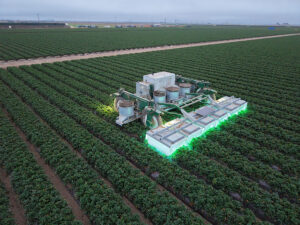
TRIC Robotics, a community member at Reservoir Farms, uses UV light against diseases such as powdery mildew and botrytis in strawberries and to suppress spider mite egg hatch.
In a Cal Poly Strawberry Center study published in Frontiers in Agronomy in April 2026, researchers Colin Koubek and Mohammad Amir Aghaee measured up to 97% reduction in twospotted spider mite egg hatch using TRIC’s UV-C platform, with Lewis mite reductions ranging from 32% to 87%. The authors concluded UV-C “should not be viewed as a standalone replacement for miticides or biological control, but rather a complementary tool to target the egg stage and slow population growth.”
In a commercial trial in strawberries, TRIC reports its UV-C treatment resulted in 30% lower powdery mildew incidence than the grower’s standard oil and sulfur treatment. The figure is a company estimate and has not been published or independently replicated.
Stager added that the technology brings secondary benefits to farms over chemical treatments, including that the TRIC UV-C treatment has no reentry interval, the time delay between a chemical spray and when people can enter the field for activities such as harvest.
The company plans to upgrade to a residence member at Reservoir Farms in 2027 as it continues to prepare to launch into the Salinas Valley, according to Stager.
“Reservoir is perfect for our expansion up north,” he said.
To date, Stager said he has found the membership at Reservoir Farms invaluable.
You’ve got companies like Andros Engineering outfitting a shop with not only the right tools, but also the right tools just feet away from the farm. So, you can get out on the farm and get to work really fast. —Adam Stager
“Right now we’re using our relationships with Reservoir to meet new customers and start to build relationships up in Salinas,” Stager said. “And we’re learning a lot. The way they plant in that region is a little different than how they plant in Santa Maria. They have a little different row spacing. So, we are able to talk to some of the farmers there and get it right before we start trying to scale up.”
Reservoir Farms hopes one day to host incubator farms in multiple sites across California, into Arizona and in other major growing regions.
For the grand opening of its flagship farm in Salinas in March, the farm drew more than 300 growers, ag leaders, federal and state officials, as well as community partners and investors. The event included demonstrations of ag tech prototypes and early-stage innovations from nearly a dozen startups.
“We really want to drive activity on our farms and create a bustling environment, a hub for ag tech,” Hoffman said. “We’ve signed about 15 companies so far, and we expect a big burst of more companies to sign as the season starts to wrap up and ag businesses start to think about what is happening next year.”
As Bernstein said: “We are building a network of places where growers, innovators and investors can work side-by-side to bring solutions to market faster. And we are just getting started.”
Frequently asked
What facilities and testing space does Reservoir Farms offer?
The site features innovation barns where companies can refine machinery with high-end fabrication equipment, office spaces and 24 acres of dedicated commercial fields where companies can test their ideas in the field.
How long does it typically take a startup to get into field testing?
Reservoir research showed that it takes about eight months from the time a startup is funded to the time it can establish a relationship with a grower and get into a field for testing.